
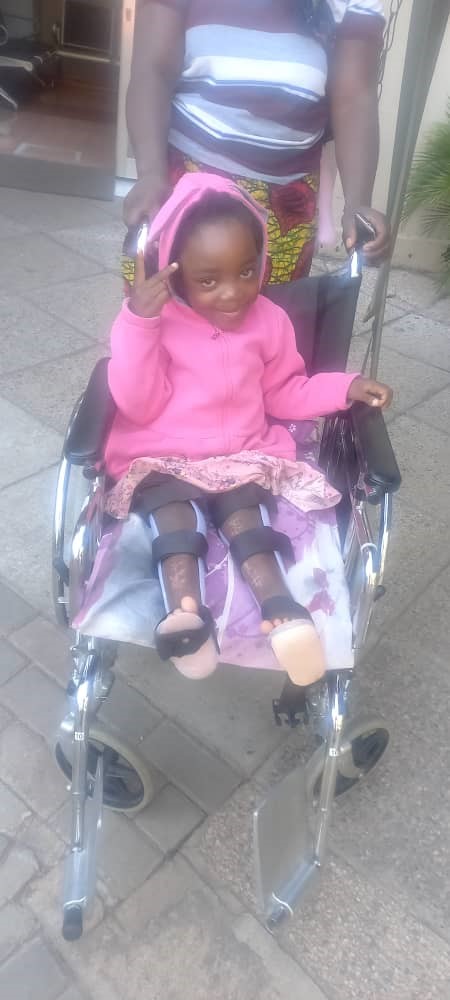
The Transformative Journey of Jane Mwale The Franciscan Missionary Sisters of Assisi (SFMA) have long been at the forefront of outreach efforts, offering healthcare, nutritional support, and physical rehabilitation to underserved communities. Their work is deeply rooted in collaboration among the sisters, healthcare professionals, and local communities. The story of seven-year-old Jane Mwale is a shining example of what can be achieved when such synergies come to life. A Difficult Start Jane Mwale was born on April 5, 2018, in Lumezi, Eastern Province. Her mother, just 16 years old at the time, received little to no prenatal care. Multivitamins and other medications prescribed during her pregnancy were discarded, and Jane was born seemingly healthy, but that changed as she began to grow. When Jane started walking, her legs felt unusually heavy. She couldn’t stand upright and would walk bent forward, clutching her knees. Eventually, her legs became visibly deformed, raising concerns and confusion in her community. A Timely Intervention In January 2025, the sisters from the Mother Angela Community, working alongside the nutritionist from Chililabombwe District Hospital, discovered Jane during one of their outreach programs aimed at supporting malnourished children. These outreach programs involve collaboration between local hospitals, clinics, and community members to identify children in need and provide them with nutritional and medical support. When the sisters met Jane, some members of her family believed she had been bewitched; a common misconception surrounding unexplained health conditions in communities here in Zambia. But the sisters, guided by both faith and medical understanding, suspected a physical condition and knew where to turn for help. A Door Opens at St. John Paul II Hospital The sisters quickly contacted their fellow SFMA Sisters at the Zambia-Italian Orthopaedic Hospital, also known as St. John Paul II Orthopaedic Mission Hospital in Lusaka. An orthopedic surgeon was consulted, and Jane was booked for a consultation the following week. For over 27 years, St. John Paul II Hospital has stood as a beacon of hope for underprivileged families in Zambia. With a mission rooted in Christ’s love, the hospital provides life-changing orthopaedic surgeries to children, completely free of charge. Jane was diagnosed with osteogenesis imperfecta, a congenital condition that weakens bones. Before this referral, Jane’s parents, Mr. and Mrs. Mwale, had nearly given up hope that she would ever walk upright. A Life Changed Jane underwent her first surgery on one leg, with plans for the second operation just two weeks later. After six weeks of recovery, she could sit upright with both legs straightened and a joyful smile on her face. Supporting her recovery were KAFOs (Knee-Ankle-Foot Orthoses), specially made by the hospital’s Prosthetics and Orthotics Department and provided at no cost. The transformation was not just physical. Jane can now look forward to going to school, playing with friends, and living a life full of possibility. She’s no longer defined by stigma or limited by disability. Gratitude and Grace Jane’s family is overflowing with gratitude to God who made this miracle possible, the Franciscan Missionary Sisters of Assisi, the dedicated doctors and staff at St. John Paul II Hospital, and all the collaborating partners whose combined efforts made this miracle possible. Jane’s story is more than just a tale of medical success—it is a testament to the power of unity, compassion, and the Franciscan Missionary Sisters’ unwavering commitment to serving the most vulnerable with dignity and love.
GRACE THROUGH THE AGES: THE ENDURING JOURNEY OF THE FRANCISCAN MISSIONARY SISTERS OF ASSISI
The Piccola Adunanza and the Storm of the Napoleonic Era (1799–1815) The Institute of the Franciscan Missionary Sisters of Assisi was founded in 1702. The first community was known as the Piccola Adunanza, meaning “small gathering,” and it was also referred to as a “Pious House.” Today, the Franciscan Missionary Sisters of Assisi continue to embrace these names as a reminder of their humble beginnings and enduring call to holiness. The Piccola Adunanza has withstood the test of time for over three centuries. Rooted in a deep desire to seek God alone. However, this humble and pious house has faced many storms that threatened its very existence. Among these, the Napoleonic Era stands out as one of the turbulent periods in our history. Yet, through divine mercy and providence, the Piccola Adunanza not only survived but emerged with renewed strength and faith. The Napoleonic Winds of Change in Italy The period between 1799 and 1815 saw profound upheavals across Europe, as Napoleon Bonaparte expanded his empire and reshaped political and religious life. Italy, a patchwork of states and territories at the time, was particularly affected. With the fall of the Papal States and the establishment of satellite republics under French influence, the Church lost much of its temporal power and property. In 1797, the Treaty of Campo Formio handed parts of northern Italy to French control. By 1809, Napoleon had annexed the Papal States entirely, exiling Pope Pius VII and initiating widespread suppression of religious institutions. In 1810, an imperial decree mandated the closure of monasteries and religious houses that were deemed non-essential. This suppression was not just political, it was a direct challenge to the very heart of religious life in Italy. The Crisis and Providential Exception Our community, founded in 1702, had grown modestly over the years, steadfast in its commitment to prayer, simplicity, and service. But in 1810, just over a century after our foundation, the Piccola Adunanza faced the threat of dissolution. The decree required all religious Sisters to abandon their habits and cease admitting new vocations. The very identity of our Institute, our way of life, was under siege. Yet God, in His mysterious providence, provided a narrow path through the darkness. The decree included exceptions for religious institutions engaged in social work, particularly education. Because our convent housed a small school attached to it, we were permitted to remain, though under watchful eyes and without the visible signs of our religious profession. A Slow Return to Life With the defeat of Napoleon in 1814 and the restoration of the Papal States, the Church began to regain its freedom. On October 26, 1819, our sisters were once again permitted to wear their habits. At the time, only four Sisters remained—two of whom were over 80 years old. But it was not the end. In that same year, a new light arose in the person of Sister Marianna Fedele Guerrini from Assisi. Though her leadership was initially unofficial, Sr. Marianna’s energy and faith were undeniable. She is rightly remembered as the Second Foundress of our Institute. With prayerful determination, she worked to rebuild the community and re-establish the school. In 1820, after a decade of uncertainty, the Institute was once again allowed to receive new vocations. It was a resurrection of sorts—an experience of the tender mercy of God breathing new life into what seemed lost. The Quiet Witness of Sr. Paola of Jesus Among the many testimonies of faith that carried the Institute forward in those years, the story of Sr. Paola of Jesus from Bagno Cavallo stands out. Frail and often ill, Sr. Paola experienced what she believed to be a miraculous healing on February 16, 1830, through the intercession of St. Joseph. This experience ignited in her a burning devotion to St. Joseph, which she shared not only with the sisters but also with the wider community of Assisi. Her humble witness of suffering, healing, and renewed zeal continues to inspire us to this day. A Legacy Carried in Faith The survival of the Piccola Adunanza during the Napoleonic era is a testament to God’s providence and the courage of faithful women who stood firm in the face of adversity. Their quiet resistance, grounded not in politics but in prayer and perseverance, is the legacy we inherit and strive to honor today. We remain grateful for the sisters who endured, for the leaders who rebuilt, and above all, for the hand of God that preserved this little gathering that sought nothing more than to love Him.
